|
||||
| Home | Resources
for Motoring History Research in South Australia South Australia is blessed with a rich motoring heritage: we are lucky to be able to see at least some of it living on in the vehicles that have survived and that are in use, or at least in existence, today. Getting at the stories behind the early vehicles, and the people who built and used them in the veteran days, is sometimes difficult. With the grandchildren of veteran motorists now in their eighties, there is not much oral history to be found, so the emphasis has shifted to the search for documents. This article is intended as an introduction to some of the resources that might be of use for researching our automotive history. State Library of South Australia The starting point for a browse of the State Library collection is the catalogue, which is available for on-line users from the State Library web page. The main catalogue contains all the (catalogued) items in the library, including books, newspapers, photographs and special items such as collections of business or personal papers. Many of the huge collection of photographs held by the library are on-line, and can best be found by searching the South Australiana Database. My preferred mode for searching is to use the "key word" search, then arrange the results by date. It pays to be a little bit creative in your search: remember that the cataloguing of the items in the collection may not have been done by motoring experts so the catalogue entries may not contain the ideal key words, and the dating may not be exact. Beware of being very specific in your search. The best plan might be to use simple terms like "motor", "car", "garage" and so on, but you will find additional items - together with many repeats - from a search for "motorist". Patience and perseverance are of use. The Library collection of newspapers and journals is impressive. There were numerous papers in South Australia in veteran times, and the Library holds copies of most of them. At present there is no on-line access, and although the originals are in the collection the preferred mode of viewing is on microfilm. Numerous readers (some with printers) are available in the library, and access to the microfilms is "self serve". By far the biggest issue with searching through papers is the sheer number of words that has to be scanned to find material of interest! It is there, but how to find it? Luckily there are some excellent aids to begin a search. One is The Manning Index of South Australian History, which is an index to literally thousands of items, mostly in South Australian newspapers. The transport section is likely to be of most interest to motoring historians. Be aware that although there are a huge number of entries in the index, they represent only a sample of the articles to be found in a targeted search. Another rich resource is the South Australian directories, published yearly by Sands and McDougall Ltd. A complete set is available in the library - most are on the shelves for public access. Searching these is a little tricky. Although there is an alphabetical section, it is not complete. Searching the alphabetical section for a business name, for example, might return and street address (and with luck some information about the business). However the business may have occupied a number of locations that are not listed in the alphabetical section. Since the other main section of the directory lists the occupants of buildings on a street-by-street basis, it is difficult to find a premisis in the directory unless you already know where it was located! Beyond the obvious resources, there are innumerable others that might supply missing links. The Police Gazette reported all manner of crime, and in the event of cycle or vehicle theft the vehicle is sometimes described in great detail. Maps of the city - called "bock plans" - show buildings at a scale of 1" = 40 ft. State Records of South Australia Luckily for us, South Australia has a place for things that people
might otherwise throw out. State
Records of South Australia acts as an archive for all manner of things relating Of course State records holds many documents beyond business records, so browsing their catalogue and consulting the archivists might unearth some real treasures. Adelaide City Council Archives For information relating to city buildings and matters that required interactions with the council, it might pay to check out the Adelaide City Council Archives. In the early days there are ledgers that list building work, and from the mid-1920s plans may be on record. Also any correspondence with the council, and follow ups, may be on record. Because of the way information is indexed, very specific requests will have more chance of success. National Archives of Australia The NAA can be thought of as the national equivalent of State records. Their collection is large and eclectic and can be searched through their on-line catalogue, accessible from their main page. All First World War records are now available on-line, and these may contain surprising detail. By the way, you'll find that "bookmarking" a page while searching the NAA doesn't work: if you hit on something interesting you'll have to cut and paste to a document (or write it down with pen and paper!) if you want it for later. National Library of Australia Again the size and scope of the collection is vast, and warrants a thorough search. Of particular interest are collections of documents belonging to notable Australians - these often contain archives of correspondence which can be of interest. Access to the catalogue is from the NLA main page. |
|||
| back to top | ||||
[ home ] Copyright © 2008 The Veteran Car Club of South Australia. All Rights Reserved. |
||||

 to the
history of the state. Among the marvellous items are a collection of business documents
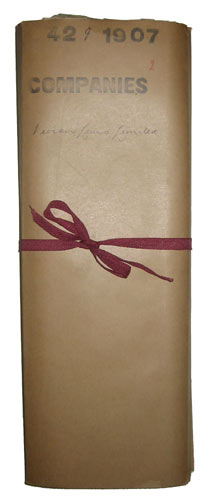
from "defunct companies": these consist mostly of documents that have been
lodged with government departments. Expect to find documents like articles of
incorporation, lists of shareholders, company resolutions and so on. With luck your
documents will look like good documents should: tied with scarlet ribbons and embellished
with wax seals and florid signatures. Some of the files have been "weeded" and
only representative documents remain, but others have an almost complete record of
business activities from preliminary agreements through to liquidation. The collection can
be searched from the "search collection" link on the
to the
history of the state. Among the marvellous items are a collection of business documents
from "defunct companies": these consist mostly of documents that have been
lodged with government departments. Expect to find documents like articles of
incorporation, lists of shareholders, company resolutions and so on. With luck your
documents will look like good documents should: tied with scarlet ribbons and embellished
with wax seals and florid signatures. Some of the files have been "weeded" and
only representative documents remain, but others have an almost complete record of
business activities from preliminary agreements through to liquidation. The collection can
be searched from the "search collection" link on the 